









PTSD Claims

PTSD Compensation Claims & PTSD Claim Calculator

PTSD Compensation is the most effective way to recover your losses and start getting your life back on track.

If you have been diagnosed with Post-Traumatic Stress Disorder, or are suffering from Post-Traumatic Stress Disorder symptoms, such anxiety, withdrawal, or nightmares, contact us today.

Brian Barr Solicitors is one of the leading firms in the UK, supporting clients across England and Wales through the process of claiming compensation for their injuries, pain, and chronic conditions.

Our team understands the profound impact that Post-Traumatic Stress Disorder can have on its sufferers. We use our decades of experience supporting clients in claims for compensation to build strong cases, and consistently achieve great results with high settlement amounts.

Contact our specialist team today, and start your PTSD Compensation Claim, safe in the knowledge you have legal specialists who understand your situation on your side.


If you have been diagnosed with Post-Traumatic Stress Disorder, or are suffering from Post-Traumatic Stress Disorder symptoms, such anxiety, withdrawal, or nightmares, contact us today.

Brian Barr Solicitors is one of the leading firms in the UK, supporting clients across England and Wales through the process of claiming compensation for their injuries, pain, and chronic conditions.

Our team understands the profound impact that Post-Traumatic Stress Disorder can have on its sufferers. We use our decades of experience supporting clients in claims for compensation to build strong cases, and consistently achieve great results with high settlement amounts.

Contact our specialist team today, and start your PTSD Compensation Claim, safe in the knowledge you have legal specialists who understand your situation on your side.


Read More

Am I eligible for PTSD Compensation?

We understand that making a claim for PTSD Compensation may seem daunting, as the legal process is complex and requires legal expertise. However, thanks to our decades of specialist experience in this field, we can help you by making your claim simple, and support you through each step.

As with any personal injury claim, the two main factors that make you eligible for compensation are proving that you have suffered because of an incident, and that the incident has taken place because of the negligence of a third party.

We can connect you with an extensive network of medical specialists who can assess the psychological injury you have suffered, and produce a medical report. This is a valuable piece of evidence, and can significantly impact the value of your PTSD Claim.

The person or entity responsible for your condition must then be proven to owe you a duty of care. This could be an employer, a service provider, or anyone who had a reasonable duty to keep you from harm.

If both of these conditions are met, you are likely eligible to claim Post Traumatic Stress Disorder Compensation. Our team can guide you through the collection and documentation of evidence, and build a strong case to maximise your settlement amount.


We understand that making a claim for PTSD Compensation may seem daunting, as the legal process is complex and requires legal expertise. However, thanks to our decades of specialist experience in this field, we can help you by making your claim simple, and support you through each step.

As with any personal injury claim, the two main factors that make you eligible for compensation are proving that you have suffered because of an incident, and that the incident has taken place because of the negligence of a third party.

We can connect you with an extensive network of medical specialists who can assess the psychological injury you have suffered, and produce a medical report. This is a valuable piece of evidence, and can significantly impact the value of your PTSD Claim.

The person or entity responsible for your condition must then be proven to owe you a duty of care. This could be an employer, a service provider, or anyone who had a reasonable duty to keep you from harm.

If both of these conditions are met, you are likely eligible to claim Post Traumatic Stress Disorder Compensation. Our team can guide you through the collection and documentation of evidence, and build a strong case to maximise your settlement amount.


Get In Touch

How we helped Samuel

£410,000 Settlement for Chronic Pain

Samuel fell down a drain while on the job, sustaining injuries to his legs and arms. The severity of Samuel’s injuries left him with permanent pain and discomfort. Brian Barr Solicitors navigated the legal challenges with skill and determination, securing a settlement that has helped Samuel deal with the ongoing consequences of his injuries.
Our Accreditations & Partners

Looking For A PTSD Compensation Specialist To Represent You?

Get in touch today to see how Brian Barr Solicitors can help you.

Picture of Steven Akerman

Steven Akerman

Personal Injury Solicitor & Director, Brian Barr

Picture of Alex Cohen

Alex Cohen

Personal Injury Solicitor & Director, Brian Barr.

Picture of Philip Cohen

Philip Cohen

Director, Brian Barr

How much is my PTSD Claim worth?

Each PTSD Claim is unique, as the circumstances in which these conditions develop are varied in manner and severity. We can assess your case in a free, no-obligation assessment, and give you an idea of how much your PTSD Claim may be worth.

Our experts calculate the value of PTSD Compensation you could receive by dividing your settlement amount into two categories: general damages and special damages.

The general damages in your PTSD Claim are designed to compensate you for the event and resulting injury themselves. The Judicial College Guidelines define the ranges of compensation for the general damages of a PTSD Compensation Claim based on severity, prognosis, and the effect that the injury has had on the claimant’s life.
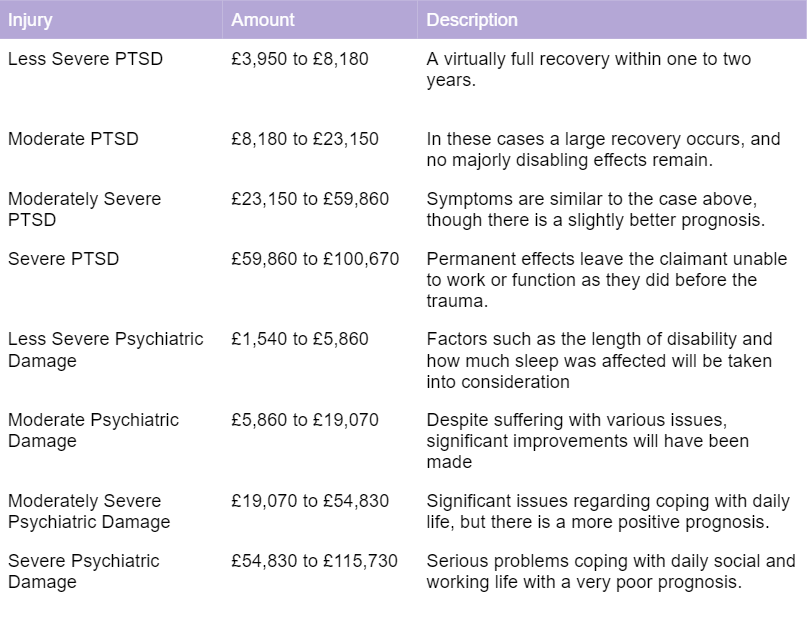
 

PTSD Compensation Amounts

In addition to this, you will receive compensation for special damages. This is a recovery of all your costs and losses, past and future. They may include:

  • Loss of earnings because of necessary time off work or reduction of work hours caused by your symptoms.
  • Medical costs, such as any expense for private medical care, specialist assessments, and counselling.
  • Costs for ongoing care, either from professionals or friends and family.
  • Costs of adaptations to your home or vehicle.


Proving these expenses will be crucial to recovering the right amount of special damages. Our team can help you keep a thorough record of any loss or expense you have incurred because of your condition, which will be fundamental to a strong case for PTSD Compensation.

Why choose Brian Barr Solicitors for your PTSD Claim

If you are seeking compensation for PTSD, contact us today. We are leading experts for PTSD Compensation in the UK, with specialist Serious Injury Solicitors. Our team has decades of experience pursuing PTSD Compensation Claims for clients across the UK, and consistently achieves higher PTSD compensation payouts than other firms.

It is crucial to have the support of specialist PTSD Lawyers when seeking compensation. Our deep understanding of the condition and its effects on sufferers helps us deliver effective and straightforward legal advice. Our personal injury solicitors Manchester can also connect you to a network of medical specialists who can provide you with a thorough assessment and produce a medical report. This piece of documentation often proves crucial in PTSD compensation claims.

We can offer our services on a No Win No Fee basis for many of our clients. This means that if your claim is not successful, you won’t need to pay any legal fees.

Contact Brian Barr Solicitors for a free, no-obligation assessment of your case, and begin the process of claiming compensation for PTSD.


Frequently Asked Questions

Building a successful PTSD claim requires clear, credible and well-documented evidence. Unlike physical injuries, post-traumatic stress disorder is not always visible, which makes strong supporting evidence essential.

In most cases, the following types of evidence will be required

  • Medical records and diagnosis
    A formal diagnosis of PTSD from a qualified professional such as a psychiatrist, psychologist or GP is fundamental. This will usually be assessed in line with recognised diagnostic criteria.
  • Independent medical expert reports
    As part of the claims process, an independent expert will be instructed to assess your condition and provide a detailed report on diagnosis, causation and prognosis.
  • Evidence of the traumatic event
    This may include accident reports, witness statements, CCTV footage, or workplace incident logs. The aim is to demonstrate that a specific event caused or materially contributed to your PTSD.
  • Impact on daily life
    Documentation showing how PTSD affects your ability to work, maintain relationships or carry out daily activities. This can include employer records, sick notes or personal statements.
  • Financial losses
    Evidence of loss of earnings, treatment costs, therapy expenses or travel costs related to your condition.


Under the Civil Procedure Rules, expert evidence must meet strict standards to be admissible in court. At Brian Barr Solicitors, we work with leading psychiatric experts to ensure your claim is supported by robust and persuasive medical evidence.

If you have developed Post Traumatic Stress Disorder symptoms following a traumatic event or incident, we understand that seeking compensation feels daunting or stressful. However, having the support of legal specialists can make the difference. Our expertise in claiming PTSD Compensation allows us to guide claimants through the process with no stress, offering jargon-free, clear, and effective guidance. A typical process for a PTSD Claim will go through the following steps:

1.        Initial Consultation

One of our experts will speak to you to gain an understanding of your circumstances, offer preliminary advice, and outline the next steps in your process. This is a crucial step: Brian Barr Solicitors is a firm believer in putting the claimant first in any legal process, so we will always seek to fully understand what has happened and how it has affected your life.

2.        Evidence Collection

We will help you collect and document all relevant information, including medical assessments, witness statements, and incident reports. We can also connect claimants with medical specialists who can produce detailed medical records, thoroughly describing the effects of your condition on your daily life.

3.        Establishing Liability

Proving the duty of care a third party owed you, and the subsequent breach, is the foundation of any strong personal injury claim. We will analyse the evidence and establish who is at fault for your injury. This could be a person or entity, including employers or service providers.

4.        Calculating PTSD Payout Amount

Based on the general damage guidelines by the Judicial College, and any evidence of financial losses and expenses, we will calculate how much your PTSD Claim is worth. We aim for your settlement amount to reflect the pain and suffering you have had to endure, and consistently achieve high payouts for our claimants.

5.        Negotiations

Our team will negotiate a PTSD settlement with the other party. You may receive a counteroffer, and we will advise you on whether to continue negotiations or bring your claim to court. Most of our clients see their PTSD Claim settled out of court, which reduces the stress associated with this type of case. However, our specialists have years of experience dealing with PTSD cases in court, and can provide expert advice and support.  Our commitment to you doesn’t end with a successful claim. We offer continued support and can guide you to counselling services and support groups.


PTSD Claims may be subject to a time limit. You will usually be obligated to begin legal proceedings regarding your PTSD Claim within 3 years of the original incident, or from when the psychological effects of the incident have first appeared. Because of the particular nature of PTSD compensation claims, this time limit can be less clear than in other personal injury cases. It can be complicated to establish a precise date of the psychological injury if PTSD has occurred because of ongoing trauma, such as long-term military or emergency service. Our PTSD Solicitors can advise you on the best course of action for your claim, but beginning the claim process as soon as you are able to can make the difference.


The duration of a PTSD claim can vary significantly depending on the complexity of the case and the severity of the condition.

Generally, straightforward cases may conclude within 12 to 18 months, while more difficult claims involving serious psychiatric injury or disputed liability can take several years.

Key factors affecting the timeline include:

  • Whether liability is admitted or contested
  • The need for multiple expert medical reports
  • The time required to understand your long-term prognosis
  • The extent of financial losses and future care needs


In PTSD claims, it is often necessary to wait until your condition has stabilised before settling the case. This ensures that any compensation awarded accurately reflects your long-term needs.


Post-Traumatic Stress Disorder (PTSD) is a mental health condition triggered by experiencing or witnessing a traumatic event. It’s more than just a response to stress or fear: PTSD is a complex condition that can have a profound impact on someone’s life. At Brian Barr Solicitors, we understand the intricacies of PTSD and are here to help you navigate through them.

PTSD can develop after a variety of traumatic events, including but not limited to:

  • Serious accidents, such as road traffic accidents.
  • Accidents at work which may arise from breaches of health and safety regulations.
  • Physical or sexual assault.
  • Military combat experiences.
  • Natural disasters, such as earthquakes, storms, or fires.
  • Terrorist attacks.
  • Traumatic childbirth, especially if as a result of
  • Medical Negligence
  • Prolonged or severe emotional abuse


It’s important to recognize that PTSD is not a sign of weakness. It is a psychological response to extraordinarily stressful situations. The path to developing PTSD varies from person to person, as does the journey to recovery.

At Brian Barr Solicitors, we don’t just see the legal case; we see the person behind it. Understanding the nature of PTSD is the first step in your journey towards seeking justice and compensation. Our team is dedicated to providing you with the support and guidance you need during this challenging time.


Yes, you can bring a PTSD claim on behalf of someone else in certain situations.

This commonly arises where the injured person is under the age of 18 or lacks mental capacity to manage their own affairs.

In these cases, a representative known as a litigation friend can act on their behalf. This is governed by the Mental Capacity Act 2005 and relevant provisions of the Civil Procedure Rules.

The litigation friend is responsible for:

Instructing solicitors
Making decisions in the claimant’s best interests
Ensuring the claim is conducted fairly and appropriately

Any settlement involving a child or protected party must be approved by the court to ensure it is in their best interests.

At Brian Barr Solicitors, we have extensive experience supporting families in these sensitive cases, particularly where PTSD arises alongside serious or catastrophic injuries.

We often see clients move their PTSD Compensation Claim from another firm to Brian Barr Solicitors. If you are currently pursuing compensation for PTSD, but not using a specialist firm, your settlement may be undervalued. We understand PTSD and the impact it has on sufferers, and we have the expertise to secure higher amounts of compensation for PTSD.

Transferring your case to us is straightforward and hassle-free. There is no obligation for you to continue your case with your current firm if you find that your payout is lower than it should be. You are entitled to switch firms at any point in the legal process if you are unhappy with your current legal representation. Contact us today to find out how to transfer your PTSD Claim to a specialist firm.


In certain circumstances, witnesses to traumatic events may be able to bring a PTSD claim. However, this depends on whether the legal criteria for psychiatric injury are met.

If you directly witnessed a shocking event and developed PTSD as a result, you may be able to claim as a secondary victim, provided you satisfy the requirements outlined above.

Key considerations include

  • Whether you witnessed the incident with your own unaided senses
  • The immediacy and severity of the event
  • The relationship, if any, with those involved
  • Whether the incident was sufficiently sudden and horrifying to cause psychiatric injury

For example, a person who witnesses a serious road traffic accident involving a close family member may have a viable claim. By contrast, witnessing an incident involving strangers without a close connection may make a claim more difficult, though not impossible.

Each case turns on its individual facts. Courts carefully assess whether the psychiatric harm was reasonably foreseeable and whether the legal control mechanisms apply.


Building a successful PTSD claim requires clear, credible and well-documented evidence. Unlike physical injuries, post-traumatic stress disorder is not always visible, which makes strong supporting evidence essential.

In most cases, the following types of evidence will be required

  • Medical records and diagnosis
    A formal diagnosis of PTSD from a qualified professional such as a psychiatrist, psychologist or GP is fundamental. This will usually be assessed in line with recognised diagnostic criteria.
  • Independent medical expert reports
    As part of the claims process, an independent expert will be instructed to assess your condition and provide a detailed report on diagnosis, causation and prognosis.
  • Evidence of the traumatic event
    This may include accident reports, witness statements, CCTV footage, or workplace incident logs. The aim is to demonstrate that a specific event caused or materially contributed to your PTSD.
  • Impact on daily life
    Documentation showing how PTSD affects your ability to work, maintain relationships or carry out daily activities. This can include employer records, sick notes or personal statements.
  • Financial losses
    Evidence of loss of earnings, treatment costs, therapy expenses or travel costs related to your condition.


Under the Civil Procedure Rules, expert evidence must meet strict standards to be admissible in court. At Brian Barr Solicitors, we work with leading psychiatric experts to ensure your claim is supported by robust and persuasive medical evidence.

If you have developed Post Traumatic Stress Disorder symptoms following a traumatic event or incident, we understand that seeking compensation feels daunting or stressful. However, having the support of legal specialists can make the difference. Our expertise in claiming PTSD Compensation allows us to guide claimants through the process with no stress, offering jargon-free, clear, and effective guidance. A typical process for a PTSD Claim will go through the following steps:

1.        Initial Consultation

One of our experts will speak to you to gain an understanding of your circumstances, offer preliminary advice, and outline the next steps in your process. This is a crucial step: Brian Barr Solicitors is a firm believer in putting the claimant first in any legal process, so we will always seek to fully understand what has happened and how it has affected your life.

2.        Evidence Collection

We will help you collect and document all relevant information, including medical assessments, witness statements, and incident reports. We can also connect claimants with medical specialists who can produce detailed medical records, thoroughly describing the effects of your condition on your daily life.

3.        Establishing Liability

Proving the duty of care a third party owed you, and the subsequent breach, is the foundation of any strong personal injury claim. We will analyse the evidence and establish who is at fault for your injury. This could be a person or entity, including employers or service providers.

4.        Calculating PTSD Payout Amount

Based on the general damage guidelines by the Judicial College, and any evidence of financial losses and expenses, we will calculate how much your PTSD Claim is worth. We aim for your settlement amount to reflect the pain and suffering you have had to endure, and consistently achieve high payouts for our claimants.

5.        Negotiations

Our team will negotiate a PTSD settlement with the other party. You may receive a counteroffer, and we will advise you on whether to continue negotiations or bring your claim to court. Most of our clients see their PTSD Claim settled out of court, which reduces the stress associated with this type of case. However, our specialists have years of experience dealing with PTSD cases in court, and can provide expert advice and support.  Our commitment to you doesn’t end with a successful claim. We offer continued support and can guide you to counselling services and support groups.


PTSD Claims may be subject to a time limit. You will usually be obligated to begin legal proceedings regarding your PTSD Claim within 3 years of the original incident, or from when the psychological effects of the incident have first appeared. Because of the particular nature of PTSD compensation claims, this time limit can be less clear than in other personal injury cases. It can be complicated to establish a precise date of the psychological injury if PTSD has occurred because of ongoing trauma, such as long-term military or emergency service. Our PTSD Solicitors can advise you on the best course of action for your claim, but beginning the claim process as soon as you are able to can make the difference.


The duration of a PTSD claim can vary significantly depending on the complexity of the case and the severity of the condition.

Generally, straightforward cases may conclude within 12 to 18 months, while more difficult claims involving serious psychiatric injury or disputed liability can take several years.

Key factors affecting the timeline include:

  • Whether liability is admitted or contested
  • The need for multiple expert medical reports
  • The time required to understand your long-term prognosis
  • The extent of financial losses and future care needs


In PTSD claims, it is often necessary to wait until your condition has stabilised before settling the case. This ensures that any compensation awarded accurately reflects your long-term needs.


Post-Traumatic Stress Disorder (PTSD) is a mental health condition triggered by experiencing or witnessing a traumatic event. It’s more than just a response to stress or fear: PTSD is a complex condition that can have a profound impact on someone’s life. At Brian Barr Solicitors, we understand the intricacies of PTSD and are here to help you navigate through them.

PTSD can develop after a variety of traumatic events, including but not limited to:

  • Serious accidents, such as road traffic accidents.
  • Accidents at work which may arise from breaches of health and safety regulations.
  • Physical or sexual assault.
  • Military combat experiences.
  • Natural disasters, such as earthquakes, storms, or fires.
  • Terrorist attacks.
  • Traumatic childbirth, especially if as a result of
  • Medical Negligence
  • Prolonged or severe emotional abuse


It’s important to recognize that PTSD is not a sign of weakness. It is a psychological response to extraordinarily stressful situations. The path to developing PTSD varies from person to person, as does the journey to recovery.

At Brian Barr Solicitors, we don’t just see the legal case; we see the person behind it. Understanding the nature of PTSD is the first step in your journey towards seeking justice and compensation. Our team is dedicated to providing you with the support and guidance you need during this challenging time.


Yes, you can bring a PTSD claim on behalf of someone else in certain situations.

This commonly arises where the injured person is under the age of 18 or lacks mental capacity to manage their own affairs.

In these cases, a representative known as a litigation friend can act on their behalf. This is governed by the Mental Capacity Act 2005 and relevant provisions of the Civil Procedure Rules.

The litigation friend is responsible for:

Instructing solicitors
Making decisions in the claimant’s best interests
Ensuring the claim is conducted fairly and appropriately

Any settlement involving a child or protected party must be approved by the court to ensure it is in their best interests.

At Brian Barr Solicitors, we have extensive experience supporting families in these sensitive cases, particularly where PTSD arises alongside serious or catastrophic injuries.

We often see clients move their PTSD Compensation Claim from another firm to Brian Barr Solicitors. If you are currently pursuing compensation for PTSD, but not using a specialist firm, your settlement may be undervalued. We understand PTSD and the impact it has on sufferers, and we have the expertise to secure higher amounts of compensation for PTSD.

Transferring your case to us is straightforward and hassle-free. There is no obligation for you to continue your case with your current firm if you find that your payout is lower than it should be. You are entitled to switch firms at any point in the legal process if you are unhappy with your current legal representation. Contact us today to find out how to transfer your PTSD Claim to a specialist firm.


In certain circumstances, witnesses to traumatic events may be able to bring a PTSD claim. However, this depends on whether the legal criteria for psychiatric injury are met.

If you directly witnessed a shocking event and developed PTSD as a result, you may be able to claim as a secondary victim, provided you satisfy the requirements outlined above.

Key considerations include

  • Whether you witnessed the incident with your own unaided senses
  • The immediacy and severity of the event
  • The relationship, if any, with those involved
  • Whether the incident was sufficiently sudden and horrifying to cause psychiatric injury

For example, a person who witnesses a serious road traffic accident involving a close family member may have a viable claim. By contrast, witnessing an incident involving strangers without a close connection may make a claim more difficult, though not impossible.

Each case turns on its individual facts. Courts carefully assess whether the psychiatric harm was reasonably foreseeable and whether the legal control mechanisms apply.


What Our Clients Say...
Success Stories from Brian Barr Solicitors

Read more about how we support client throughout the UK to claim compensation for their injuries or chronic pain conditions. Brian Barr Solicitors consistently achieves great results and high compensation amounts.

Get In Touch

To start your claim, simply complete the form below and we will be in touch shortly.

Processing...
Thank you! Your subscription has been confirmed. You'll hear from us soon.
ErrorHere